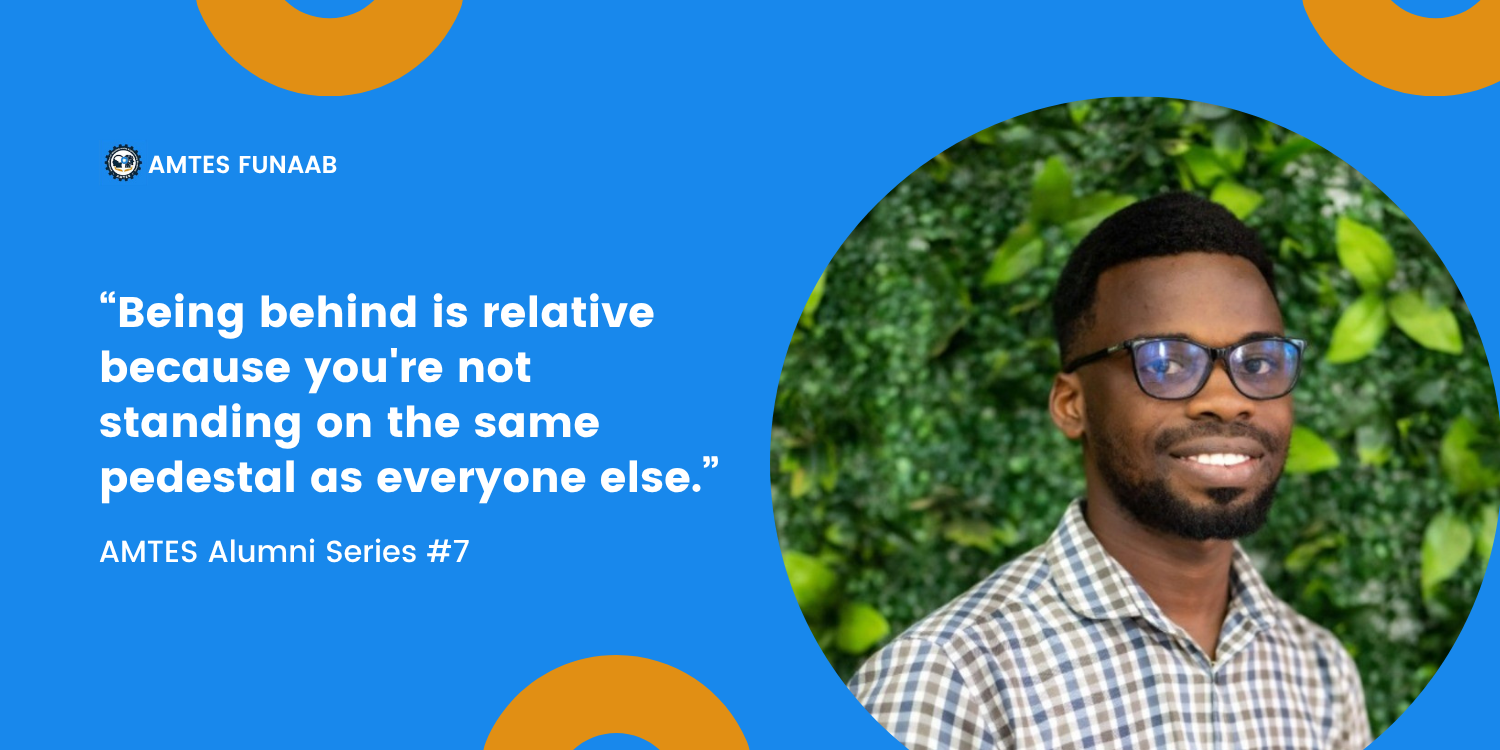

Research wasn’t something Adedayo Akinade planned from the beginning. Looking back, he describes his career as a series of opportunities that kept leading him to the next one. From carrying out research at EPFL, to working on social robots during his master’s degree at CMU Africa, and now pursuing a PhD, each experience built on the last.
But what stood out most during our conversation wasn’t just the research. It was the parts people don’t usually see. Moving to a new country and struggling to adjust to the food. Walking into rooms filled with brilliant researchers and wondering if you belonged there. Learning that self-doubt doesn’t simply disappear, no matter how far you go. Through it all, he kept showing up, one day at a time.
In this interview, as part of our AMTES Alumni Series, Adedayo shares what his journey into research has really looked like. We talked about his master’s thesis, life at EPFL, adapting to new environments, dealing with self-doubt, and why he believes no one is truly “behind.” His story is an honest look at what it takes to keep moving forward, even when you don’t have all the answers.
Hello once again, Adedayo. It’s a pleasure to have you here, and I hope your day is off to a great start.
The interview should take about an hour, so hopefully we’ll be done by 10. I know you have another engagement afterward, so I’ll try to keep things moving. I have about 10 questions for you today, so let’s get right in.
I ask every interviewee this question because I’m always curious about how they found their way into mechatronics. So, to start us off, why did you choose to study mechatronics, and what got you interested in the field?
I should probably answer your question with another question first. Do you want the honest answer, or the polished one?
(laughs)
To be honest, I’ve tried to reflect on it, but it’s been a while. I’d say I’ve loved engineering from a very young age. I enjoyed taking things apart and putting them back together. I would open up radios, televisions, broken blenders, and faulty fans just to see how they worked.
Growing up, most of the people we knew who repaired these things were technicians, and I was always fascinated by the engineering behind the devices themselves. That curiosity stayed with me as I got older. So when I got to secondary school, it wasn’t a difficult decision to go into the science class. That part was straightforward.
Getting into university, though, was a bit of a funny story. The first time I applied, I was hoping to study Electrical and Electronics Engineering at the University of Ilorin. I barely met the cutoff mark—I think I scored around 182 or 186 in JAMB; I can’t remember the exact score. In the end, I didn’t get admitted because the cutoff was higher.
While I was preparing to write JAMB again, I think it was my former principal who told me about this new course called mechatronics in FUNAAB. The impression at the time was that, because it was a new programme, it might be easier to get admitted into.
When I started looking into what mechatronics actually involved, I realized it combined mechanical engineering and electronics, which really appealed to me. My dad wanted me to study civil engineering, but I wasn’t interested in building roads or bridges. I was much more interested in electronics.
At the same time, I wasn’t particularly drawn to Electrical Engineering. I was more interested in electronics than electrical systems. So when I came across mechatronics which combines mechanical engineering with electronics, it just felt like the right fit for me.
There was also the cliché that if you studied mechatronics, you could work anywhere. So between that and the fact that it was a new programme, I was convinced to give it a shot. I also thought it would be easier to get admitted because it was new.
Ironically, when I got in, I realized that almost everyone admitted was among the best of the best. I was probably one of those who had just made the cut.
So that’s really the background. It was a combination of my existing interests, the opportunities that came along, and the guidance of good people around me who encouraged me to pursue what I was genuinely interested in.
Well, we’re certainly glad you ended up in the department.
One thing I’ve noticed from speaking with many of our guests is that they all have similar stories about finding their way into mechatronics. Very few of them actually set out to study mechatronics from the beginning. Somehow, they all found their way here, and it’s really interesting to see how things have unfolded for each of them since then.
But just to quickly digress, were you part of the first set of mechatronics students at FUNAAB?
What do you think?
(laughs) I actually think you were… but I’m not completely sure.
That’s funny. Most of us haven’t really looked back since we left the department. Life has a way of keeping everyone busy. But yes, I was part of the very first set of Mechatronics Engineering students. That was when the programme was first introduced at FUNAAB, and I was fortunate to be in that inaugural class.
Let’s just let’s just say we suffered to make things good for you guys to enjoy right now.
(laughs) Thank you. Thank you for that. Okay, so my second question is: What was your academic journey like? Were there moments when you struggled, and how did you push through? Also, what was your most memorable experience as a student at FUNAAB?
To be fair, university was full of different emotions. There were highs and lows, but I think the most important part of the experience was the community we had because we were the first set. We didn’t have any guidance on how things were supposed to be done. If you were an Electrical Engineering student at the time, for example, there were already students in 500 level who could tell you, “Take this elective,” or “This is how to approach this course,” or “This is the internship you should apply for.” We didn’t have that luxury. We had to figure everything out ourselves.
In a way, though, that made the experience more interesting because everyone in our cohort was learning together. It was stressful, but we were all trying to solve the same problems at the same time.
The journey definitely wasn’t without its challenges. Our lecturers also had to figure things out alongside us, and they really did their best to help us find our footing. Since the programme was new, there weren’t many resources available. A lot of the materials and structures that exist today simply didn’t exist back then. In fact, many of those resources were created by students over time. Looking back, I think that’s what made the experience so memorable. Rather than joining a system that was already established, we got to build it. We formed the first departmental association. AMTES was established by our set.
Literally, most of the foundation that students see today was built by a class of about 30 people. I don’t know how many students are in the department now, but imagine trying to build an entirely new department with just 30 students. There are probably many reasons you won’t find a lot of pictures of me from that time (laughs), but when I think back, what stands out the most are the people—the community, the lecturers, and the experience of figuring everything out together. Looking at what the department has become today and seeing how well you all are doing is really rewarding.
Yeah, that’s honestly incredible to hear because even with the resources we have now, the programme can still be challenging. So I’m trying to imagine what it must have been like navigating an entirely new department with almost no resources and having to figure everything out as you went along. It’s amazing that you all persevered and laid the foundation that the rest of us have been able to build on.
Okay, moving on to the next question. We’re going to move the conversation slightly away from your time at FUNAAB and start talking more about your experiences beyond university. But before we get there, I wanted to ask, many students struggle with balancing good grades and building practical skills. During your undergraduate years, how did you manage that balance? I also know you graduated with a First Class, so what habits or approaches do you think helped you achieve that while still making time to build skills outside the classroom?
I would say it was a combination of taking advantage of the opportunities that were available and, of course, following the classic principles of being diligent and always doing your best.
More importantly, though, I tried to make the most of every opportunity. We were also fortunate that, especially toward the later part of the programme, the academic environment wasn’t overly harsh. Most of our departmental courses were structured in a way that genuinely helped us learn rather than simply testing us.
One thing that really helped was leveraging the people around me, working with others, learning from classmates, and not limiting myself to just people within my department. There was always something to learn from those around you.
To be honest, if you’re not in an overly harsh academic environment, getting good grades isn’t as complicated as people sometimes make it seem. On paper, the system is straightforward. Tests are worth 30%, exams are worth 70%. You prepare for your tests, you prepare for your exams, and you earn your grades.
Of course, that preparation doesn’t start the day before a test or an exam. It’s the accumulation of everything you’ve learned over a 13-week semester.
What really matters is everything that happens between the first week of classes and your final examination, the lectures you attend, the assignments you complete, the concepts you take time to understand, the reading you do, and yes, even the sleepless nights. When you consistently put all those pieces together, the grades naturally become much easier to achieve.
Yeah, that actually makes a lot of sense. I think many of us fall into the habit of trying to study intensely the night before a test or an exam, which only makes things more difficult. Giving yourself enough time to truly understand the concepts definitely makes learning much easier.
Exactly. It rarely works when you try to cram everything into a very short period.
A semester lasts about 13 weeks. Of course, there are situations where some courses don’t start on time, or a lecturer suddenly has to cover three or four topics in one or two weeks. Those things happen.
But if you average it out, you still have an entire semester to learn the material. From the first week, you should be working to understand what you’ve been taught. If you get to Week 6 and you’re still struggling with what was covered in Week 2 or Week 3, there’s a good chance you’re already falling behind. Then by Week 13, instead of revising, you’re still trying to understand concepts from the middle of the semester.
That’s why starting early makes such a difference.
I tried to follow that principle as much as I could. But like I said, it’s really a combination of many things. Most importantly, it’s about consistently doing the things we already know we’re supposed to do. The challenge isn’t usually knowing what works, it’s actually doing it consistently.
At the same time, we also have to recognize that everyone has different circumstances. Some students have to work to support themselves. Others have family responsibilities. You can’t expect everyone to be able to give the same amount of time and energy.
But, on average, we should all strive to do our best. At the end of the day, it’s still a full-time course, regardless of whatever else we may have going on.
That’s true. So, moving on to the next question. Was research always part of your long-term plan, or was it something that developed gradually as you progressed through your academic journey? Also, at what point did you decide to pursue graduate studies?
That’s a tricky question because it’s hard to point to one defining moment.
Research, in itself, or the concept of research, is really about trying to solve a problem or trying to find a way to solve a problem. That’s something we’ve always been doing. Of course, everything we’re learning is trying to prepare us with the basics. If you want to build, I don’t know, a circuit, for instance, you need to understand all of the basic principles, Ohm’s law, Kirchhoff’s law, and so on. Those are things that are taught during undergraduate studies.
But the concept of research wasn’t really a big deal, especially in the first three or four years. Even for many people, the final-year project wasn’t really seen as research. It was just a project. It was just something we needed to graduate.
So, in a way, the concept of research as it’s commonly understood now wasn’t really a thing during undergrad. And I imagine it was probably the same for many people. But the real idea behind research has always been there, trying to solve problems. That’s the reason I decided to study mechatronics. I just loved pulling things apart, putting them back together, and trying to make them better.
I think there was also this perception that once you said you were doing research, everyone expected you to be doing a PhD. But you can still do research without being in that official capacity. That’s why I said it’s a tricky question.
But at what point did I decide to pursue graduate studies? Like I said, it has also been a gradual process.
During my undergraduate years, I was usually someone who tried to focus on the present because, at the end of the day, nothing is guaranteed tomorrow. So, during undergrad, my priority was simply getting my bachelor’s degree. That can be a bad plan, if you ask me, just focusing on getting the bachelor’s and leaving tomorrow to sort itself out, but sometimes that’s all you can do.
So, especially during the first three or four years, there wasn’t really any concrete plan to pursue graduate studies. But during my final year, when I started working on my project, it became a mix of actually doing research while also trying to complete a graduation project. At that point, the idea of a research career became very interesting to me.
Coming from a place like Nigeria, and from the kinds of backgrounds many of us come from, without sufficient financial support, the easiest and most direct route into research is really through academia. People who have more financial backing have other options. I know a couple of colleagues who went on to become research scientists at companies like Tesla and Apple. You can absolutely do research in industry.
But I didn’t have those kinds of resources. I couldn’t simply travel out of the country or decide that I wanted to get a job at Tesla. It was possible, but I didn’t even have the skills at that point. So the easiest and most feasible path for me was graduate studies.
There’s also another aspect to it. Within the academic system in Nigeria, if you graduate with a First Class, there’s almost an expectation that you’ll go into academia unless you deliberately choose to go into industry instead. So there was that as well.
That said, when I finished my undergraduate studies, I didn’t go straight into graduate school. I worked in industry for a little over two years before leaving for my graduate studies. So it wasn’t like I finished and immediately went to grad school. I still spent time in industry.
The point is that it wasn’t really a plan that had been there all along. It developed gradually. At different points, I realized it was necessary. I also realized I had the qualifications and the opportunities.
For instance, my first publication came from my final-year project. I think it was published in a Q3 journal or something like that, but it was still my first publication. That experience made research seem feasible. It became something that felt attainable instead of this far-fetched idea. So there wasn’t a specific point where I decided, “I’m going to pursue graduate studies.” It was more of an ongoing development that happened over time.
Like I said, I’ve always enjoyed solving problems and doing research. Given my circumstances, the easiest or most direct route into research was academia. So that’s the path I took.
Exactly. I feel like I can also relate to that because, during my first three years in school, I wasn’t really thinking about academia, graduate studies, or research. But at the moment, I’m at the point where I’m thinking, “Okay, I think this might be a good next step.” At the same time, though, I feel like I’m more inclined toward industry. I’m not a huge academia person, so I’m also just trying to make decisions and figure out what the next step looks like. Like you said, I’m trying to figure things out along the way.
But you mentioned skills, especially coming from Nigeria, and that actually ties into my next question. What was your experience like stepping into research roles at EPFL and CMU Africa, especially coming from an undergraduate and early-career background in Nigeria? Like you mentioned, we didn’t necessarily have all the resources available to us at FUNAAB. So I guess this question is really about understanding the transition, moving from one environment into another with better resources, better facilities, and perhaps different expectations in terms of skills. How did you navigate that transition?
Yeah, I think that’s a good question.
I mentioned earlier that many of the core skills we needed had already been taught. To be honest, our lecturers in Nigeria are doing their absolute best. The issue is really systemic; it’s not necessarily about the lecturers themselves.
Most of the time, you take a course in 100 level, for instance, Materials Science, and then, for the rest of your four or five years, you don’t really do anything directly related to Materials Science again. Then, when you get to your final-year project, you’re expected to use your knowledge of Materials Science to choose materials for your robot or whatever you’re trying to build.
But by then, you’ve forgotten most of what you learned four years earlier, mostly because, at the time, you were just trying to study enough to pass. Now you’re trying to graduate, and you realize you need those concepts again.
But the point I’m trying to make is that the first step is really having a strong foundation. It’s not necessarily about academics in this case; it’s about the basics. If you take the fundamentals seriously, they’ll stay with you. For example, if you go back to the foundational mathematics you learn in your first and second years, you’d be surprised that many of the AI models being built today are fundamentally based on linear algebra. It’s just a more advanced application of linear algebra.
So if you’re going into research in those areas, having a solid background in linear algebra is going to help you tremendously. It’s the same across many fields. The first thing is really your foundation. Taking some of those courses seriously can make a huge difference. Of course, it’s hard to take every single course equally seriously, so you also have to be selective and do your best with each one.
That foundation helps when you move into a more developed research environment because you’re not fundamentally different from the next person you’re working with. The difference is usually that they have a stronger grounding in the basics than you do.
At that point, you may find yourself having to go back and relearn those fundamentals over and over again while also trying to keep up with your research. You’re essentially doing two jobs at the same time. The advantage, though, is that it’s much easier because you now have access to better resources. You’re provided with materials to learn from, and you can actually make use of them.
But the transition itself isn’t necessarily the difficult part. It’s just an event. What really matters is how you handle that transition. And while our educational system in Nigeria doesn’t always provide us with everything we wish it did, it does teach us one very important skill: the ability to adapt, or perhaps more accurately, the ability to adjust quickly. Because that’s what fits our reality. It fits the lifestyle and what is required of you.
That’s the reason why you find a Nigerian graduate who studied Chemistry but ends up working in banking. They never studied accounting, but when they get into the industry, that’s what’s required to earn a living. That’s the reality of life. Then they have to figure out how to use the computer and learn everything they need for the job. Whereas, four years earlier, they were busy titrating solutions and doing all those experiments in the lab.
So while we may not have had all the resources, for instance, many of us literally studied under candlelight because there was no electricity and all of that, we come out of that experience with a skill that some other people may not necessarily have. I think resilience is the right word, but it’s more than just being resilient. It’s being resilient enough to quickly adjust, recognize what you’re lacking, and then figure out how to fill those gaps.
So, like I said, it’s not really about the transition itself. It’s about realizing what you need to learn and then picking it up along the way. You keep picking up whatever skills or foundational knowledge you need in order to fit into the new environment. At the end of the day, everyone wants results, regardless of how you achieve them.
If you get a research role and you’re required to build a robot, what your employer wants to see is the robot. They don’t really care whether you already knew how to program or not. But if you’ve been given the opportunity, then it’s your responsibility to learn how to program so you can build it.
Even though, back in school, we barely did any programming. I think the only real programming we did was C programming in 200 level, and maybe a little bit again in 400 level. That was about it. Now, though, I do a lot of programming. So it’s really a case of picking up the skills along the way, both before you get there and while you’re there.
Of course, it’s always good to prepare ahead because you can’t, for example, expect a mechatronics graduate to get a research role in chemistry. You probably wouldn’t even get the opportunity in the first place because you don’t have the foundational knowledge.
But if you already have the basics, or you have the opportunity to build those basics, then I think that’s the most important part. Once that foundation is in place, the Nigerian in us helps us fight through everything else. We adapt, we adjust, and we keep going.
You eventually realize that the next person isn’t necessarily better than you. They’ve just had more resources and more opportunities than you have. You may not be able to close that gap overnight, but you can keep improving and become better than you were yesterday.
Exactly. Beautifully worded response because I honestly hadn’t thought about it that way before. It’s definitely been a bit of a mindset shift for me.
Okay, so moving on to the next question. Can you give us a peek into your master’s thesis? What was it like coming up with the initial idea, working through the project, and eventually arriving at your final results? I’m not really expecting a heavily technical answer. I think we just want to understand your thought process like how you came up with the idea, what it was like working on the project, and the results you eventually got.
Hmm, another tricky one. First of all, I have a very technical response to that.
(laughs) Okay, well, it’s fine. You can—
No, no, no. I’ll just give a quick, short answer. To be honest, my whole career has been shaped by a lot of opportunities anyway.
My master’s thesis was in social robotics. Basically, I was trying to build robots that interact with humans or, more accurately, build systems that interact with humans. That was the focus of my master’s work.
As for the journey from idea to implementation, my work was actually part of a larger project. I was contributing to a broader research project within the university. So I did my background research, explored a few ideas, and figured out how my work could contribute to the larger project. More specifically, I was trying to build robots that interact with Africans in ways that Africans would naturally want to interact with them. That was the focus of my work.
So the idea came from an existing research project. I identified an area where I could contribute, developed my own research idea around it, figured out how to implement it, and then, at the end of the project, evaluated whether my hypothesis was supported by the results.
That was essentially my master’s thesis.
Hmm. This might be a bit of a stretch, but did you happen to work on something related to Pepper? I think that’s the name of the robot.
Yeah.
That’s amazing!
How did you know?
I actually met Pepper last year.
Really? Where?
At the Deep Learning Indaba. It was held in Kigali, and they brought Pepper along, so I got to see it there.
Oh, okay. Yeah, Pepper was the robot I worked with. That was the only Pepper robot we had at the time. They were probably trying to showcase some of the work we’d done. I don’t know exactly what they presented. When was Deep Learning Indaba held last year?
It was in August.
August. Okay. They probably showcased some of the work we were doing then. I’m not sure if you saw it, but yeah. That was the robot we were working with. We actually had two Pepper robots.
Wow, that’s very cool. Okay, so the next question is somewhat similar to the last one, but this time I want to focus a bit more on your overall research experience at EPFL. Can you share one story from your experience at EPFL that captures both the challenge and the excitement of doing research?
Um, that’s tricky. I think one of the biggest parts is something people like to call imposter syndrome, but I don’t necessarily think it’s imposter syndrome.
Because imposter syndrome is when you’re qualified, but you feel like you’re not. In some cases, you’re actually not qualified, or at least you feel that way when you compare yourself to the people around you. So it’s hard to really call it imposter syndrome.
When you have the opportunity to interact with all these people—Europeans, Americans, people from different backgrounds—there’s already the culture shock. You’re trying to adjust to a completely new environment while also doing your best work. At the same time, you’re trying to meet what you think are their standards because you already feel like you’re not up to those standards.
That mindset can make you either overwork yourself or underestimate yourself, and neither is particularly healthy. We’ve grown up in an environment where every result requires an enormous amount of effort. It’s like you have to put in 200% just to get 80% of the outcome. Then you get to a place where, if you put in 100%, you actually get 100%—or even 120%—of what you expect. That’s a huge shift in mindset.
The excitement comes from realizing that every one of your efforts, every one of your thoughts, every one of your actions actually yields a result.
I remember during my final year project. At our final defence, luckily for us, my supervisor had seen the system working the day before. So he really stood behind us during the defence. He kept saying, “I saw this thing work.” That was honestly our saving grace. Because if it hadn’t worked that day, we could have ended up with a very bad result because of that single moment.
Out there, though, my supervisor would always say, “Everything that can go wrong during a demo will always go wrong.” But the difference is that the people evaluating you are often more understanding. They know demos fail. They don’t assume that one failed demonstration erases all the work that went into the project.
Coming from where we come from, that difference can be difficult to adjust to. Sometimes it makes you want to overwork yourself because you’re used to believing you have to be perfect.
At the same time, it’s still important to work hard because your battle is different. The people sitting in the same room as you, when everything is over, have a home to go back to. You, on the other hand, might feel like you’re carrying the hopes of your family, your community, or even your country. That sense of responsibility is very real.
So it’s new people, a new environment, new food—everything is new. All of it takes a toll on you.
But most importantly, the resilience—the Nigerian in us—doesn’t let us give up.
Mm-hmm. Actually, I don’t know if this is me digressing, but I feel like what you described just now is exactly what a friend of mine experienced. She did a three-month internship last year at Max Planck, and I remember the first two weeks she was always complaining about the food. She was like, “Oh, I miss jollof rice.” It was a struggle adapting to the food.
And then the same thing about trying to overwork and trying to make people proud. I remember she was really hard on herself regarding her project, always saying, “Oh, I need to figure something out.” She was at work during weekends when no one else was there. Hearing your experience just made me think back to her experience as well.
Yeah, yeah. Those little things really matter a lot, but sometimes people don’t really see them because they just see you out there. You’re probably eating bread, or eating something that has no pepper, or eating something that has no spice. Coming from an environment where we’re heavy on spice and food and all of that, it takes a toll on your mental health. Then you can’t even produce as much as you want. So all of those adjustments are always hard.
And it’s even harder if you’re going there for a short-term stay. If you’re going for internships and stuff, it’s harder because while you’re trying to find your footing, by the third month you’re being pulled out again.
But if you’re there for your master’s or PhD or something, it’s ongoing. So you spend the first six months trying to understand things. And once you do, you just become like this robot that has a routine. You know what to do, you know what to cook, you know what to eat, and you’re eating the same thing over and over again. That’s a different problem entirely.
But you just have to adapt. As I said, the resilient Nigerian in us always refuses to give up. Even if it means crying on your bed every night, you still come out, snap pictures, and post them. Yeah, so that’s just it.
Mm-hmm. Okay, we’re almost done. We have about 10 minutes left, and I don’t want to eat into your time. We have about three questions left.
So for question eight, choosing to pursue a PhD is a long and demanding commitment. How did you decide that you wanted to pursue a PhD, and what made you confident that it was the right next step for you?
Okay, I’m going to start with a question. What makes you think it’s a long and demanding commitment?
I’ve spoken to some people doing PhDs, and for five years they’re trying to work on different projects, get results, write papers, and adapt to, as you said earlier, different environments.
Yeah. You’re right. You’re right in the sense that a PhD is long and hard. It’s a long journey, and it’s hard. The problem is that no one really knows how hard it is until you get there. Because even if you’ve been told that it’s hard, there’s a part of you that still feels like, “It’s not that bad. It’s just running a bunch of experiments and doing them.” So, to be honest, no one really wants to suffer if they don’t have to. Why would you want to suffer? But for different personal reasons and different career reasons, people choose to do a PhD. I don’t think anyone is essentially signing up for a PhD because they know it’s hard.
You don’t decide, “Oh, it’s hard, so I just want to go and do it.” You do it because… I wouldn’t even say because you’re going to enjoy it. You just have to find a way to enjoy it while you’re there.
But as I said earlier, to be honest, that’s a question I haven’t really thought about in the sense of saying, “Okay, this is why I’m going to do my PhD,” or, “I know it’s hard, and I’m still going to do it anyway.” As I said, I’m doing it because research has been my thing. There are so many factors that have contributed to me getting here. The opportunities, the PhD opportunities, were things that came my way. Of course, you apply for them, but the point is, if I didn’t get one, I probably wouldn’t have gone for it.
But then it felt like the next natural step for me, especially given that it’s a long commitment. Most times, it’s even a lifelong commitment because, even after you’re done with your PhD, whatever you’re doing afterwards almost revolves around research, unless you decide to quit research completely and become, maybe, a model.
Even if you decide to become a model, you’ll still find yourself unconsciously doing research. What’s the latest thing in town? How do I make it better? All of those things are research. It’s just that research has become a glorified title, or it’s more emphasised for some people than for others.
So yes, research is long and hard. I didn’t choose it because it’s long and hard, and I don’t think anyone chooses it for that reason. People do it because they think they’ll enjoy it, because they want to do it, because they need it for the next step of their lives, or because they want to upskill. There are just a bunch of different reasons.
But yes, I agree with you that it’s long and hard. Don’t get me wrong. I was just saying that you’re told it’s long and hard, but you don’t really know what that means until you get there.
Exactly. I think it was something similar with my undergraduate studies as well. I had a lot of people say, “Oh, university is very hard. This is bad, that is bad.” But I don’t think anything they said could have prepared me for the actual experience.
Yeah, you can never be overprepared. You can never be too prepared.
But the next question, I feel like you’ve already sort of answered it, but I think I’m still going to ask it just in case you want to add anything. The question is basically about how you moved from your undergraduate studies to your master’s and now your PhD.
How did you deal with, I want to say, self-doubt or imposter syndrome at each stage?
To be frank, I don’t think there’s an exact way to deal with it. It’s not something you can wrap up in a bag and throw in the bin. It’s not something you can simply get rid of. It’s something you’re going to have to do what you have to do regardless. It will always be there. Well, it’s arguable. Some people may say they become very comfortable over time, but there’s always a stage where you become so good at one level that you seek the next step. Then you get to that next step and realise you’re not as good as the people there. So you work to become good again, and then you seek the next step.
So my point is, I don’t think anyone can ever completely deal with it. You can manage it; that’s the better word to use. But my candid advice is that, regardless of what you feel, you have to do it. Most PhDs out there are funded. Someone is paying you to come and do the PhD. So, if for no other reason, you have to wake up every day and do it. It’s like a job. You have to wake up every day and go do it because you’re going to get paid. The alternative is to quit and go back home. So whether you feel incapable or you feel less confident than everyone else, you still have to show up.
The only way to manage it is to do things that make you a bit more confident. For example, you may feel out of place because you’re in a room where people are talking about some algorithms or some technical topic, and you don’t even know what to say.
But when you leave that room, you should ask yourself, “Why don’t I know about this?” Not because you’re blaming yourself—there are many reasons why you may not know about it—but because you want to learn. You want to say, “Okay, let me go and understand what they’re talking about.” And the interesting thing about a PhD, or maybe the sad thing, depending on how you look at it, is that, as my supervisor puts it, there’s a sample that represents the whole world or the entire academic space, and then there’s one tiny dot. Just one tiny dot. That’s where your PhD is.
At the end of the day, that’s the one thing you know really well. That’s what you’re doing with your life. You’re waking up every day, reading papers about it, implementing this, implementing that, trying this, trying that. Then you write a paper, submit it, it gets accepted, you present it, come back, and continue working. Then you finish four or five years of your life, and that’s still the thing you know best. Meanwhile, someone else is talking about something completely different, and you’re like, “Wait, when did that happen?”
So it’s that kind of situation. But as I said, you just have to do it regardless of how you feel. I don’t think you really want to push the feeling away. The feeling will always be there. If you focus too much on trying to push it away, you get nothing done. The feeling will always be there, and different things will trigger it, ranging from results that are not up to standard, to approaching deadlines, to family issues back home, to the weather, to food you can’t eat, to being sick, to simply not feeling motivated.
So there are many things that will come up, but at the end of the day, you just have to keep showing up. Someone once said that a PhD is not about who is the smartest. It’s about the person who keeps showing up for however many years it takes and eventually gets the degree. So that’s what I would say. There’s really no quick fix to it. You just have to keep showing up regardless. Over time, you sort of get used to it. It’s like having an injury in your arm. Over time, you become used to using your arm the way it is. It doesn’t mean the injury is gone or that you’ve become a completely new person overnight. That’s just not possible.
Thank you so much for that response. I think it really captured what I was going for, and it was nicely worded as well.
Okay, so we have about a minute left, and we’re on our final question. I’m so sorry about the time and everything. But the last question I have is, if a student reading this feels like they’re “behind,” what do you hope they understand after hearing your story?
What do you mean by behind?
Behind in terms of the people around them, basically. For example, I’m currently in my final year, and there are other people in their final year as well. Maybe they have certain skills, they know certain programming languages, or they’ve had certain experiences. They might feel like, “How do I catch up? I feel like I’ve wasted my school years. This person is already on a better footing than I am.” So what do you think they would need to hear regarding that?
That’s a bit… I think they would be a bit harsh on themselves because everyone’s journey is different. Your path is different, and the opportunities that come your way as a person are also different.
Like I said, I have friends and colleagues who left for graduate studies immediately after school, and I also have friends who left for graduate studies after I did—maybe two years later or something. That doesn’t make them any less, and it doesn’t make me any better than they are.
At the end of the day, it’s a case of whatever life deals you, you have to try to play it as best as you can. So, for instance, if you have better skills than someone else, the question is: What are you going to do with those skills?
If someone has better grades than you, of course, if you could have had better grades, that’s fine. But if someone has better grades than you, the question is: What’s the best you can make out of your own grades? If someone has better skills than you, as you said, can that person actually make good use of those skills? And if you don’t have those skills, what can you do with the skills you do have? Or does it mean you need to go and acquire those skills so you can achieve what you want? So, at the end of the day, it’s about playing life as it comes because, realistically, you can’t outdo the leverage you have. You can’t outwork the opportunities you have. Well, in very rare cases you might, but generally you can’t outwork the opportunities available to you.
For instance, if you graduate with a first class, apply to graduate schools, do everything you possibly can, and still don’t get in, you’re not going to stop living because of that, right? As I said, you want to make the best use of the opportunities you have. At the same time, it’s not about settling for what you have or settling for your current situation. You also want to look at where you want to be and ask yourself how you can become better.
For instance, if you want to go to graduate school, can you talk to people who are currently doing graduate studies? What do you need to do? Are you already doing those things? Can they give you insights? When you graduate, with what you already have, how can you package it better to improve your chances for graduate school? If you don’t want to go to graduate school and you want to go into industry instead, then ask yourself: How do I get into industry? What do I need? Even though things may look a bit bleak initially, over time it becomes clearer what you want to do.
And as I said, I didn’t start my graduate studies until more than two years after I graduated. That doesn’t mean I was less intelligent or less capable. It’s just that opportunities come at different times. That’s why I asked what you meant by being behind. Being behind is relative because we’re not all starting from the same place.
I had friends who were already running businesses while we were undergraduates, and today they’re doing very well—really successful businesspeople. At the time I graduated, I could have looked at myself and thought, “The only thing I have to show for all these years is my degree certificate. I don’t have anything else.” But several years later, I’m doing fine, and they’re doing fine too—or at least we’re each doing fine according to our own definitions of what that means. It’s not a competition. It’s simply a case of asking yourself, “How can I become better than I was yesterday?” So, in the end, you want to stick with what works for you and what’s best for you, while making the best use of what you already have.
If you have just five seeds of corn, you can’t expect a whole plantation immediately. You first have to plant those five, then replant and replant. Whereas someone else who has a sack full of corn seeds can plant them all and have a plantation in no time. So it’s really a case of making the best use of what you have.
Decide what you want, find out what you need to do to get there, and start making moves toward it. At the end of the day, it’s a personal journey.
Amazing. That’s a great way to wrap up the interview. Thank you so, so much. I’m sorry we went over time, but it was honestly really amazing speaking with you and learning from your experience. I’m sure everyone reading this is going to learn a lot from your story.
Yeah, thanks again.
Thank you as well!
Adedayo’s story reminds us that everyone is fighting a different battle. It’s easy to look at someone else’s grades, skills, or achievements and feel like you’ve fallen behind. But as he explained, everyone starts from a different place and has different opportunities. The important question is not where someone else is. It’s where you are and what you’re doing to get to where you want to be.
Throughout the conversation, one message stood out: you don’t have to wait until you feel confident before taking the next step. Make the best use of the opportunities in front of you, keep learning, and trust that your path doesn’t have to look like anyone else’s to be meaningful.
For every student who feels like they’re falling behind, Adedayo’s journey is a reminder that being “behind” is often just a matter of perspective. What matters most is continuing to grow with what you have today while working toward where you want to be tomorrow.
From all of us at AMTES, we celebrate you!
You can connect with him on LinkedIn.