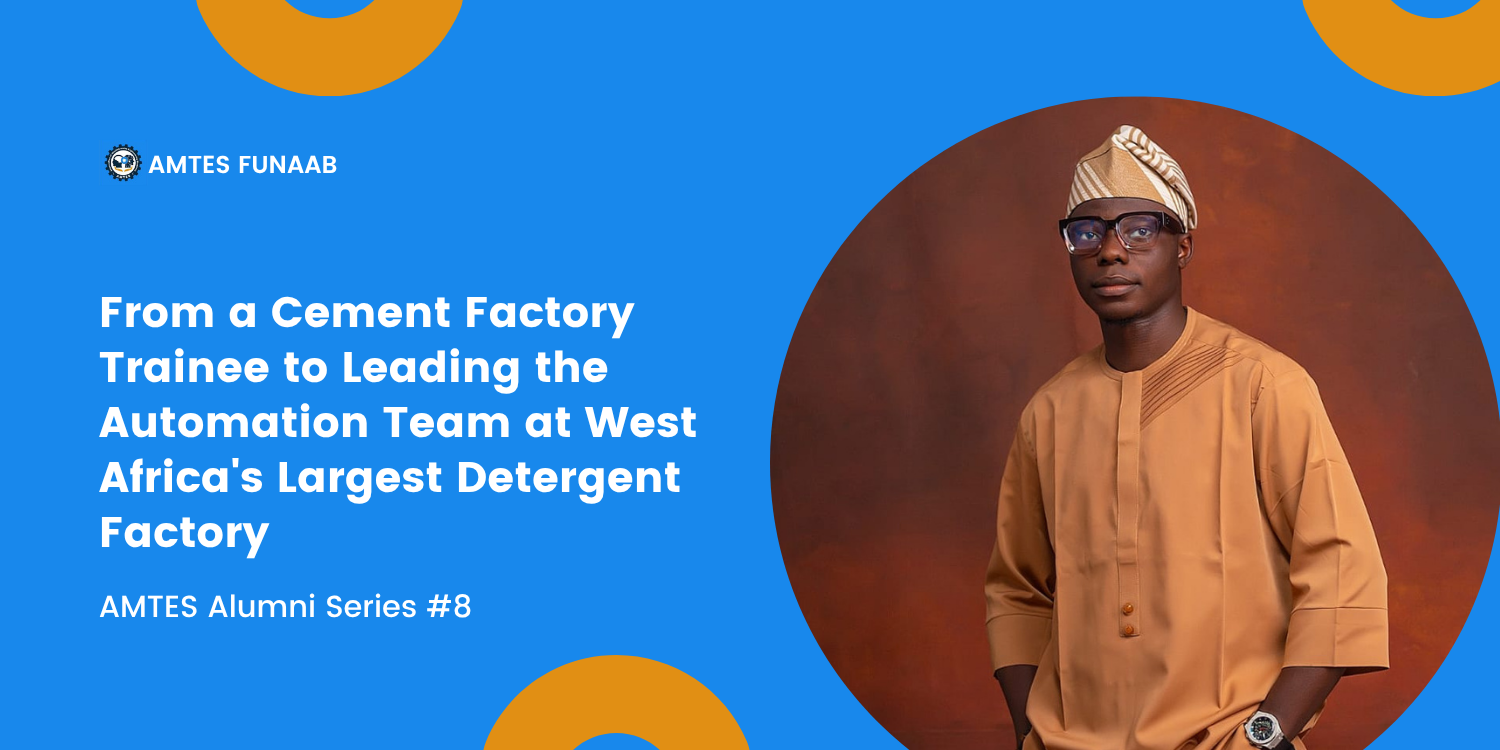

Wahab Elegbeji’s journey into engineering was not something he had fully mapped out from the beginning. In fact, Mechatronics was not even his first choice. He initially applied for Electrical Engineering, but through a twist of circumstances, he found himself in Mechatronics and later discovered that it was exactly the field that aligned with his interests in automation, control, and instrumentation.
Looking back, Wahab describes his journey as one shaped by exposure, mentorship, and taking advantage of every opportunity that came his way. From his early experience at Lafarge which changed how he saw engineering, to managing electrical and instrumentation operations at one of West Africa’s largest detergent factories, every stage of his career helped him understand what it truly means to be an engineer.
What stood out most during our conversation was more than just the technical knowledge he gained, but also the lessons behind the journey. Learning that grades alone are not enough without practical skills. Making career decisions by seeking guidance from people already walking the path. And realizing that growth comes from constantly learning, solving problems, and making yourself valuable.
In this interview, as part of our AMTES Alumni Series, Wahab shares the story behind his journey from a student discovering Mechatronics to an engineer leading automation processes in industry. We talked about his undergraduate experience, his time at Lafarge, balancing academics and skills, career decision-making, working in industrial automation, and the advice he would give students who are still figuring out their own paths. His story is a reminder that sometimes the path you did not plan can become the one that leads you exactly where you need to be.
Okay. So, yes, As-salamu alaikum. Good morning once again. It’s a pleasure to have you here, and to speak with you.
My name is Toyibat Adele, and I am one of the bloggers for the AMTES blog. We have several interview series, one of which is our Alumni Series, where we interview past alumni from the department to catch up with them and see how life has been after graduation.
The goal is to bring back tips, and positive encouragement for our current students to look forward to after graduation. So, I’ll get right into it. I have a list of ten questions, and this interview is supposed to run for about an hour. Hopefully, we don’t go over.
For the first question, I ask all of our interviewees this because it helps us understand how they got into the department and what their journey into Mechatronics was like. So, why did you choose Mechatronics Engineering?
Yeah, thank you very much for the introduction.
Actually, I didn’t choose Mechatronics, let me put it that way. I chose Electrical Engineering. But along the line, I got an offer for Mechatronics. Well, I already had a passion for power machines, process control, and condition monitoring. There is a particular specialization in Electrical Engineering that focuses on instrumentation and control.
During my set, we had a screening interview. I had actually applied for Electrical Engineering, so after completing my interview, I later found out that I was a better fit for Mechatronics than Electrical Engineering because of my interest in level control, process control, process monitoring, condition monitoring, and things like that.
So, I got an offer to study Mechatronics. It wasn’t planned. Actually, had I known then what Mechatronics was, I would have chosen Mechatronics myself. I was thinking that through Electrical Engineering, I could specialize in instrumentation and control, condition monitoring, automation, and areas like that. You understand. There are several areas of specialization within Electrical Engineering itself.
But I felt that Mechatronics was a perfect fit because it covered everything I was looking for. So, I accepted the admission for that reason.
That makes sense. I feel like a common theme I’ve noticed across almost all the interviewees I’ve spoken to is that most of them didn’t actively set out to choose Mechatronics. It was almost like Mechatronics found them along the way, and it’s been really beautiful to observe.
Okay, so the second question I have is going to take you back to your academic journey. I know it’s been a couple of years since you graduated, but this is just to take you down memory lane.
What was your academic journey like? Were there courses that you struggled with, or did you have any memorable moments as a student in FUNAAB? If so, could you share one with us?
Okay. My academic journey was a lot, I would say, because there were so many ups and downs along the way. There were times I struggled with my grades, and there were times I struggled with my personal life as well.
I don’t think there was any particular course I struggled with. Initially, when I started, I had the mindset that because I used to have very good grades before coming to the university, I would naturally continue having very good grades. But if you don’t plan yourself properly and you don’t know how to study at the university level, your grades can start dropping.
When they released our first-semester results, it was sometime during the second semester, my GPA was around 2 point something. It was a huge shock to me. Had I known earlier, I would have prepared differently. When I saw the result, it was a big challenge for me. I kept asking myself, “How could I have this kind of grade?” It was something very new to me because it was below par.
That was my first major challenge. But I was able to recover. Even though I didn’t eventually graduate with a first class, I came very close. I started off with a poor GPA, but by the end, I was very, very close to making a first class.
One of my memorable moments on campus was when we became the third set of Mechatronics students
Oh wow.
At the time, the department only had partial accreditation. I was lucky enough to witness the department receive full accreditation, and I was one of the students selected to meet with the accreditation panel.
It happened after we returned from our SIWES during 400 level. By then, many of us had gained practical experience. Some people had learned about PLCs, some about pneumatic systems, others about programming, and different technical areas. We all came back with a lot of hands-on knowledge.
It was during that period that the accreditation exercise took place. The department started bringing in new equipment and training rigs that we hadn’t had before. When the accreditation team arrived, the department had already selected about five students from my level and a few others from different levels to represent the students. I was among those initially selected.
But the accreditation panel said, “No, you cannot select the students for us. We will choose them ourselves.” So they collected our matriculation numbers and selected students randomly. At the end of the day, I was still among those they selected.
They then started the practical assessment. They would point to someone and say, “Okay, come and operate this PLC. If your lecturers have been teaching you, you should know how to operate it.” All of us performed brilliantly. We did very well in the practical sessions on electropneumatics, PLCs, and the practical applications in general. We were all very happy because, at the end of the day, the department received full accreditation. That was one memorable moment.
The second was during my final-year project. Right from my 100 level, I already had ideas about what I wanted to build by the time I got to my final year. So when it was time to choose project topics, Dr. A.T. Oyelami, the HOD then, was my supervisor.
I proposed several topics, but he didn’t approve them. Eventually, he approved one that was very interesting to me: a voice-controlled robotic arm using a Bluetooth application. The idea was that the robotic arm could be trained to understand voice commands and respond to directional instructions.
For example, if I wanted it to perform a pick-and-place operation, like to pick up an object and place it somewhere, I could give it voice commands to do that. It was a really good experience because I was able to take the project from the paperwork stage all the way through the design, implementation, and final deployment.
Actually, I had so many challenges during the project because I wanted to 3D-print the robotic arm. The 3D printing process took a long time. I had to send my design to China. I sent them the design along with the specifications of exactly what I wanted for the robotic arm. Eventually, I got exactly what I wanted. The parts were manufactured in China, shipped to me, and I assembled them myself.
I programmed the hardware myself, and I also designed the Bluetooth application. I was able to use the app to control the robotic arm, so it was a very memorable and challenging experience for me.
As for courses, I didn’t really have issues with any particular course. The only issue I had was that I didn’t have the right direction for studying. I wasn’t following the right approach or pathway. I simply didn’t have the right information, if I should put it that way. Once I started getting the right information, my grades improved consistently every semester until I graduated.
So sorry, just so I understand better, when you say “the right information,” do you mean things like understanding what different lecturers want to see in exams, or reading past questions? Is that what you mean?
Yes. When I talk about the right information, I mean understanding that different lecturers have different personalities. There are some lecturers you need to understand first. Some lecturers are looking for specific things, but you’re giving them something else.
Things that they are not looking for, yeah.
Exactly. For example, you might know that a particular lecturer wants you to give the answer exactly the way they taught it. They don’t want you to brainstorm or add extra things. They want you to present it just the way they gave it to you. So, if you are trying to do things outside what the lecturer expects, you may not do well in that course.
You need to understand your lecturer. You need to know which ones require you to pay attention to continuous assessments, and which ones require you to focus on your tests or exams.
Then, you need to look at past questions. Study the pattern of those past questions. How does the pattern look? Has the lecturer been teaching this course for a while? What is the pattern they follow?
If you can do those things, then I can assure you that you will always have better grades.
Thank you for that. I don’t know, hearing your experience was just like watching the department from a different lens. I can imagine how it must have been not having full accreditation back then and then selecting a certain number of people. That’s crazy.
Thank you. Yeah, and the information we had then was that if we failed to pass accreditation, they would have to move us to another department. They would dissolve the department. So, it was very challenging. We had to put in our best to pass.
That’s crazy.
For the next question, a lot of students feel confused about whether they should focus on building their grades or building skills outside of what they are taught in the classroom, or whether they should try to find a balance between both.
So, I want to ask, how did you navigate balancing your academics and whatever skills you had to learn during your undergraduate years?
Yeah, what we need to understand is that we can focus on academics. At the same time, we can focus on our grades and our skills without affecting each other. We can do both at the same time. It just requires some steps.
The first thing I would encourage people to do is to always seek God’s direction.
God’s direction is very, very important in whatever you want to do. His direction and guidance, that is number one.
Number two is that you have to have very strong determination. A very strong determination such that you want to redefine your status quo. You say, “I don’t want to remain at this level anymore. I want to upgrade myself.” You have to have a very strong determination that this is where I’m going, and I must achieve this by all means. So, determination is very, very important.
When you remember that, “Okay, I want to redefine my status in school. I don’t want to remain like this. Where would I be in the next one year, two years, and so on?” Those thoughts become an internal drive that keeps pushing you forward. Whenever you want to relax, you think about those things and keep trying. So, that is the second thing I would recommend.
Then, thirdly, it is about time management.
There should be time for everything. When I talk about time management, I would say it is about work and personal life balance. You need to be able to balance your work and your personal life.
Your work, in this case, is your academics, your grades. You are trying to get good grades, and you also want to pursue your skills. Those are the things you are working on.
Then your personal life is your social life. You want to do other things, unwind, and enjoy yourself. You don’t have to keep working, working, working around the clock every time. You have to set time for everything.
There should be time when you say, “Okay, this is the time I need to focus on my grades.” There should also be time to work on my skills, and there should be time for my personal life.
Maybe you want to play sports or do whatever makes you happy personally. You have to be very conscious of it. You have to plan yourself. Time management is very, very important.
For me, I focus more on academics on weekdays. I don’t wait until the exam period before I start studying. I make sure that whatever topic I am taught today, I already understand it before the next lecture. So with that, it’s not like you are piling up too much workload. You are already preparing yourself. You think, “Okay, I already know this.” In fact, you may even understand it before you leave the class. You are already setting yourself apart when it comes to your grades.
And for your skills, whichever skill you want to learn in your field of study, you need to move with people whose thoughts align with your goals. For example, “Do I want to be a programmer?” Then, do I have someone who is already into programming? That is the person I need to look closer to. Do I want to learn a particular skill? I have to look for someone whose thoughts align with my own goals. That is the only way you can focus on balancing your grades with your skills.
Then, that takes us to mentorship. You need someone to mentor you on what you want to do because you already know that the person has experience in that area. Someone who doesn’t have knowledge about something you want to do cannot really tell you the right path to take. It has to be someone who has already been doing what you want to do. That person can tell you, “Go through this path. Don’t go through this path.”
With that, you can combine so many things. During weekends and at night, for example, I used to create time for learning. Sometimes, I would use about 30 minutes a day just to balance my spiritual life and other personal activities.
I would dedicate that time, and at the same time, it would not allow everything to interfere with each other. I wanted to do well academically. I wanted to develop my skills. At the same time, I wanted to maintain my spiritual life and my personal life.
So, that is the advice I would give anyone struggling to achieve this balance. It is possible to achieve both. It is very, very possible.
I love the way you structured the sequence of your answers and how everything progresses. First, you should have a connection with God, then you should be determined. After that, you should have proper time management and surround yourself with people who can guide you towards your goals.
I feel like this is also another common theme that I’ve seen from the other interviews as well. It means that these are actually things that, when you put them in place, can help you achieve this balance.
Okay. So, moving on to question four, you’ve had several internship experiences at companies like Lafarge, Honeywell, CDK Industries, and Flour Mills.
I want to ask if you can share an experience from one of these roles that you learned from and that still helps you to this day.
Yeah, talking about the places where I’ve had internship experiences, I have to commend every one of them because of the things I learned. But the one I would commend the most is Lafarge. I would commend Lafarge because my career in engineering actually started there.
Initially, I wanted to study medicine, but along the line, after I finished secondary school, I saw an advert from Lafarge Cement. They were recruiting fresh SSCE students, people who had just finished secondary school. When I saw the advert, I picked up the form and applied. I didn’t even know what the outcome would be or what exactly I was applying for.
The first stage was the usual online exam with an aptitude test, quantitative reasoning, and things like that. I passed the first stage. I was representing my community, and I passed the first stage among over 1,000 candidates.
The second stage was the interview section, and I passed that as well. After passing the interview section, I went for the final stage, which was the medical examination. I passed the medical stage too.
At the end of the day, they selected just 21 people. Seven from Sagamu community, seven from Iwokuru community, and seven from across the different states in Nigeria. I was among the seven selected from Sagamu community.
So, we started the training. The training lasted for 18 months, a year and a half. Don’t forget, I had just finished secondary school. During those sessions, I was new. I was just coming into the field, and I didn’t even have a passion for engineering at that point. I was just exploring.
The moment we got there, we started with induction into the field, safety induction, and learning about the plant terrain and everything around it. From there, we started class activities. The class was hybrid. We had classes every day, practical sessions every day, and we had access to sophisticated and very expensive equipment. Lafarge was sponsoring everything.
We had a lot of equipment. Everybody had their own tools, everybody had their own equipment, and we had access to those facilities.
For the first three months, we were doing general studies. We were doing mechanical studies, electrical studies, and instrumentation studies. Those were the three courses we focused on for a good three months.
Every day, anything we learned in class, we had access to the particular equipment related to that theory. So, we were able to work on those things every day.
Wow.
After those three months, we started doing projects as well. Then, after those three months, we wrote our exams and went for plant attachment. Let me call it on-the-job training. When you are doing on-the-job training, you have to learn on the job as well. The things we had been learning theoretically and practicing, we now went to the plant to see how they worked in real life.
So, we did that for another good three months. By the time we came back, everything was assessed, our plant assessment, practicals, theory, everything. We were given percentages and grades. After that, everyone could decide whether they wanted to specialize in electrical, mechanical, or instrumentation.
For me, I chose electrical. So, from that point, we stopped doing the general courses and focused on our different specializations. Initially, the 21 of us were taking general studies and general courses, but after that, we were divided into the different areas.
I specialized in electrical. For a good six months, I was doing electrical practicals and theory. Every day, we had lectures, practical sessions, projects, tests, everything.
Wow. Even on the weekends?
No, no, we didn’t go on weekends. We only went from Monday to Friday.
After six months, we went for another plant attachment for another six months.
During that period in electrical, those electric motors you have been seeing, the PLCs, sensors, actuators, we were seeing those things live and direct and applying what we had learned. We were also facing challenges because, at that time, I remember the pressure was high. They would tell us that if you don’t perform well, they would send a report back to the training school and say, “This person is not doing well. Remove him from the training,” and things like that.
They were also paying us every month. This was in 2014, and they were paying us ₦30,000 every month. We had access to free meals, free medical care, staff buses that transported us, and at some point, we had access to guest houses and their club facilities. We also had access to a lot of sophisticated equipment that we used.
So, at the end of the day, after 18 months, I was the best student in electrical. We wrote the final exam, and I was the best student. I was also the third overall in the college.
So, that was it. That experience changed my orientation about engineering. It made me completely change my perspective from medicine. Because when you are learning those things, you are taught the theory, but you don’t always know how to apply it in real life.
But with this experience, I had access to these things every day. I could practice them every day.
Exactly.
I’m sure you understand. It gave me more direction. It made me see things more clearly. I started thinking, “Okay, this is the engineering that I am doing.”
So, I would really commend Lafarge for that. Lafarge set the path for me in engineering, and it changed my orientation about everything.
After we finished the 18-month program, initially, they used to give jobs to the trainees. Once they gave you a job, you automatically became a staff member and eventually became a supervisor. But during our own set, there were some management issues, so we were not employed permanently. We just finished our program and everyone went their separate ways.
From there, during my second IT, I used the certificate I got from Lafarge to get a job. I worked for almost a year as an electrical technician. Then, when I finished and applied to the university, my parents said, “Oh, you have to go back and get your degree.”
So, I had to apply to the university.
That sounds like such an amazing experience. The fact that, as you’re learning the theory, you can immediately connect it to the practical side of things, sounds like a dream.
I can imagine how impactful that was, transitioning from wanting to study medicine to fully focusing on engineering because that just sounds like an amazing experience. I didn’t even know we had something like that in Nigeria.
Yeah, we do. Even Nestlé is doing something similar. So many companies are practicing it like that.
I know because I was among the beneficiaries of Lafarge’s on-the-job training program. I was among them, and I can say that they completely set the path for me.
Okay. That makes sense. Wow.
So, for the next question, I want to ask, you’ve had different experiences. At first, you said you were interested in Electrical Engineering, and now you currently work in instrumentation.
There was also a point when you were studying Mechatronics and were interested in process control. I feel like every single time you had to make a decision about your next steps like what opportunities to apply for or what field you wanted to focus on, there was probably some uncertainty about what to expect or whether you were making the right choice.
So, the question is just to ask how you dealt with those situations, the uncertainty, making those choices, sticking with them, and seeing what they eventually led to.
I know there are people who, for example, want to go into frontend engineering or machine learning, but they are unsure about which one to pick or what the opportunities in those fields look like.
So, I just want to ask how you approach that kind of decision-making process.
Yeah, the way I made my final decision was through exposure.
I met a lot of people while doing my on-the-job training, and that completely changed my orientation. I met a lot of graduates. They were not only entry-level graduates; there were graduates from different universities who were already engineers.
They were already registered by COREN. So, when I studied their paths, I would ask questions like, “Okay, you are a mechanical engineer. You are an electrical engineer. You are in instrumentation.”
That was one of the things that helped me choose Electrical Engineering.
I discussed with a lot of them because I worked with them. At the same time, I worked with expatriates. There were expatriates from Italy who worked at Lafarge, and I was able to understand how they approached their careers.
I started asking questions like, “What does this field involve? What are the opportunities available? What are my strengths? What are my weaknesses?”
I was able to see those things clearly from people who were already practicing in the field, including our facilitators. These were people who had been in the field for a long time. None of them had been in the field for less than 30 years, so they had a lot of experience, both theoretical knowledge and practical field experience.
So, I was taking direction from there, and I was getting mentorship from there. I would ask, “Okay, what do I need to do next?” And they would tell me, “You have to do this before you can achieve this.”
I had a lot of people I could always talk to, and they would direct me on the investments I needed to make. I also saw that the particular things they were doing were things that interested me, and they were things I needed to work on. I needed to improve my skills in those areas.
So, I followed their path because I already knew how successful they were and how far they had gone in their fields of study. It wasn’t confusing at all. Rather, it convinced me and made me say, “Okay, yeah, this is the right path.”
I don’t know if I answered your question.
Yeah, I feel like you did because that was what worked for you. I think it’s also something that can actually help when someone is struggling with making this kind of decision.
“Can I speak to people who are already taking that path?”, “Can I understand what their experience has been like?”, I think that is something that would work for other people as well.
Okay. So, for the next question, you currently manage the electrical and instrumentation team at West Africa’s largest detergent factory. What does a typical day in your life look like?
Actually, there was a bit of mystery behind that role. Before I talk about the electrical and instrumentation role, I have to explain how I got there.
I got a job three months before I finished NYSC. I was doing my NYSC at Flour Mills, and during that period, I kept applying for jobs. Eventually, I got this particular job. I don’t know if you know PZ Cussons.
Yes, I do.
Yeah, so this particular company is under PZ Cussons. That is where I work.
I came for an interview, and I applied for a mechanical engineering role. Because I already believed I could integrate so many things. I was ready for any job, but I was also desperate for a job, let me put it that way. So, I went to the company for the mechanical engineering role.
So, while I was doing the interview, the maintenance manager noticed something on my CV, moving the interview towards electrical. I was not applying for electrical, but I had the experience, so the interview moved in that direction.
I started working three months before my NYSC ended. I was still going for my clearance during that period. I was on probation for six months. After the probation period, I was supposed to be confirmed.
While working on the field, they noticed that I had experience in the things I was doing, the way I handled tools, the way I solved problems, and the way I troubleshot issues. So, immediately after I finished my probation, I was promoted to lead the electrical instrumentation team. Although I am the youngest in the department. I am very, very young compared to the others. There are people in my department who are over 40 years old.
A day in the factory is a lot. I do a lot of coordinating with the team.
You know, when you are very young and you are coordinating people who are much older than you, you have to apply wisdom. You can’t just talk to people anyhow. So, I do a lot of coordination.
I inspect every day. I coordinate. I supervise the team.
Secondly, I do a lot of troubleshooting. If anything goes wrong in the plant, I have people I report to. I have expatriates from India who I report to as my bosses. So, if anything happens in the plant, before you even tell your boss that something has happened, you have to tell them what you have done so far. That is why I do a lot of troubleshooting. For example, “This process is not working. Why is it not working?”
I start solving problems. Sometimes, the issue can take a long time to resolve. We can spend eight hours trying to solve a problem while the plant is down. You have to keep thinking about what could be causing the problem. So, I do a lot of troubleshooting every day.
And I also do a lot of documentation. You know, you have to prepare daily reports. I have to write reports on our energy consumption. We make use of different types of energy, like electricity and gas, and we consume a lot of these resources. So, I have to keep records of these things.
This is so I can present them to management and say, “Okay, this is where we are. This is what we have achieved. These are our shortcomings, and these are areas where we need to improve.” So, I do a lot of documentation. Those are the things I do day in and day out.
I can imagine how intensive it is.
It is very, very tedious, I would say. Very, very tedious. Sometimes, I can be at home and they will call me to come to the plant because there is an issue.
So, the more you practice, the more you know.
Your response actually ties very well into our next question. You mentioned always having to troubleshoot and fix issues, so that’s exactly what our next question is about.
Running the electrical and instrumentation team at such a large facility likely means that you constantly have to solve problems or deal with different challenges. What is the most interesting instrumentation or process issue that you have ever diagnosed, and how did you solve it?
Yeah, I’ve had a lot of issues with feedback. You know, the way we make use of feedback, if I tell you to do something and you do not give me feedback, I wouldn’t know what is happening. So, we have a lot of feedback issues in the plant. For example, you are sending a signal to a sensor, but the sensor is not responding. Why is it not responding?
You are sending a signal to an actuator, but it is not giving feedback. Then you start having problems. I work on a lot of feedback issues, and I’m very good at solving them. For example, a signal has been sent, but maybe a valve, which is an actuator, refuses to open. What could be the problem? You start thinking about a lot of possible causes.
Also, you can have a sensor that is meant to detect something. For instance, we package cartons of detergents. Suddenly, you notice that the cartons are continuously passing through, and nothing is stopping them, even though the sensor is supposed to stop the process. That means there is a feedback issue.
So, we have a lot of feedback problems in the plant, especially with instrumentation. At the same time, we also had a lot of issues with electrical systems. In electrical, we refer to it as sending a command.
We have a SCADA system, which is a screen where we can monitor all our devices in the field. We can monitor their conditions like is the temperature high? Is there too much vibration? We can monitor their condition from the screen.
At the same time, we can operate any of those pieces of equipment in the field. We have more than 500 pieces of equipment, close to 1,000 pieces of equipment, and with a single system, we can control all of them without even going there to operate them.
So, I really find feedback issues interesting to solve. You know, it gives you a lot of challenges, and the more challenges you face, the more insight you gain into how to solve problems.
There was one issue I personally worked on and solved. Even my boss and the expatriates could not solve it. So, he gave me the opportunity and said, “Okay, I want you to work on this project.” What the project involved was an automatic pumping system. You know, in a detergent factory, wastewater goes into the system, and there is a pump that keeps pumping. When the wastewater is finished, the pump should stop automatically.
I was able to fix a very complex problem that had been there for over six months.
I think your responses have painted a really nice picture of what your role entails, and they have brought some things I probably did not even think about into the limelight.
When you talked about feedback and sensors not getting the feedback they are supposed to get, I was like, “Wow.” I can’t imagine having to solve different types of feedback issues constantly.
On question eight, from what you have said so far, I understand that a lot of the processes have been automated, with sensors, actuators, and different systems working together. But I want to ask, what is one part of the existing processes that has not been automated, and why does it still require human input? Why has it not been automated yet?
Even for an automated system, I would put it this way: there must be something to prompt you to say, “Okay, start operating.” You need a command.
An automated system always needs something to prompt it before it can work. Maybe you need to press an input or do something. It is not as if automation eliminates human intervention completely; it only reduces it.
You know, when you just press a button and a process involving 500 operations starts working, you have initiated the process. That is the minimal intervention required.
But we still have some processes in the plant that we are trying to figure out. It is about the way we pack our detergents. Actually, we have machines that automatically pack the detergents, but we do not have a machine that can arrange those packs. We do not have that yet. So, humans still have to go there and arrange those things manually.
Instead of having a robot or something that will pick all the packs and arrange them on pallets, humans are still doing that. Also, the way the detergent is processed, it is usually in the form of a slurry. So, we make use of a system that is very difficult to work with. It requires a lot of effort to rebuild it, so that is also an area where we still have partial automation.
At the moment, we are still trying to figure out how to make it completely automated, where we can just press a button and everything starts. But currently, there are some other steps we need to carry out manually.
Yeah.
So, I just got a notification that we have five minutes left. We have two more questions, so hopefully we can finish them within the given time, so I don’t take up more time than I already have.
The next question is, many students are unsure about what skills to focus on. From your experience, what technical and non-technical skills should they prioritize if they want to succeed in automation and control?
Okay. I’ll talk about the technical skills first.
They need to learn programming skills. Programming skills are very, very important.
You know, you have to program those processes depending on the kind of logic you want to use. Programming is essential. Your PLC needs to be programmed. Your DCS (Distributed Control System) also needs to be programmed. You have to learn different programming languages, maybe Python, C++, ladder logic, and other programming skills that are relevant to automation.
Secondly, you need to understand sensors, actuators, and controllers. You need to know them very well, the way they operate, their nature, and how they work together.
Then, you need to work on network protocols. For example, you want to connect your PC to a PLC. You need to understand different networking processes, like the way they do it with Cisco, connecting Ethernet cables, Modbus, and other networking protocols. There are a lot of networking protocols that you need to learn.
How can I transfer my data from my system to the PLC? How can I upload from the PLC? How can I download to the PLC? What type of communication medium do I need? Do I need an Ethernet cable? Do I need Profibus? Do I need optical fibre? You need to understand different networking protocols.
Then, you need to learn how to design and configure HMI, SCADA, and DCS systems. SCADA allows you to monitor devices, just like I mentioned earlier, where we have screens that allow us to monitor and operate different processes. They need to learn how to configure SCADA, HMI, and DCS. SCADA means Supervisory Control and Data Acquisition, HMI means Human Machine Interface, and DCS means Distributed Control System. They need to understand how to configure and work with these systems.
Then, they need to learn troubleshooting. Troubleshooting skills are very, very essential.
Talking about the non-technical part, they also need to learn how to make use of software. Although some of these are technical, they need to learn how to analyze data because data analysis is very important.
They also need to have knowledge of PID, Proportional, Integral, and Derivative controllers. PID is very common in plants. They need to understand how to tune and auto-tune PID controllers.
With all of these skills, it becomes easier to navigate the field of automation. However, knowledge is dynamic, so you have to keep learning. There are always new technologies and new developments, and you need to keep improving yourself.
They also need to learn about modern automation systems. There is less reliance on physical wiring now. Previously, we had a lot of relays, contacts, and physical connections, but things are changing.
They need to learn about electro-pneumatic systems as well.
They also need to know how to use general software tools. Whether it is Excel, Microsoft Word, PowerPoint, or other general software applications, they need to know how to use these tools effectively.
With that, they will be able to integrate a lot of things together.
That was very detailed. I feel like for anybody interested in automation or control, just listening to or reading this part of the article already gives them a good understanding of the things they need to learn and where to start.
Thank you for making that response very detailed. So it’s 11 on the dot now. I’m so sorry that we’re going over time a bit, but this is our last question. Thank you.
So the question is, if you could go back to your younger self during a moment of uncertainty about what your future career path would look like, what would you tell that person now, seeing how your journey has unfolded to where you are today?
You’re welcome. No problem.
Well, I would say you have to trust the journey.
You already said, “Okay, I want to study mechatronics.” You need to trust that journey, knowing that this is the plan God already has for you. Then you need to have the mindset that your degree is just the start.
I always encourage people to have very good grades. Try to make it to first class, not just for the sake of it, but because it is very encouraging and impressive. However, your degree is just the start of everything because you need to learn how to integrate all the things you have been learning in school. Because when you get to the field, they won’t ask about your degree, whether you have a first class or a second class. They won’t ask about that. They will ask about what you can do.
Can you solve problems? What problems can you solve? And what do you have to offer?
It is not just about certificates now; it is about what you can do. I know many people who do not even have the best academic background but are doing very well in their fields.
They have technical know-how. They have ideas. They have a lot of potential.
They have a lot of problems they can solve. So you should look beyond your degree. A degree is very important because it means you are educated, and it can open doors for you, but you should have the mindset of asking yourself: how do I integrate everything I have been learning from my academics, my IT experience, and everything else?
How can I integrate all of these and become a better person for myself?
So you need to take it very, very seriously.
That is what I would have said to myself. Trust the journey and keep moving. Not everyone will end up following the same path. For example, you are a technical writer, but it’s not everybody who will become a technical writer. It’s not everybody who will study artificial intelligence. Some people, at the end of the day, will go into business. Some people will become farmers or pursue something completely different.
But the major thing is that they went for a degree for a reason, and it is important to utilize the reason why you pursued that degree by making use of what you have learned.
Let’s forget about the idea that Nigeria does not have a plan for us. You can create your own plan. When you have something to offer, that is when people will recognize you. It is about your portfolio. What do you have? What have you been through? Can you solve problems?
That is what it is all about when you get to the labour market, because the labour market is different. The labour market is tougher than the university. It is more competitive.
The more valuable you are, the more opportunities you get and the better you become.
Yeah, I feel like you really did. There is a lot of value to be gotten from this article, and because of how well you answered the questions. It was such an honor and a pleasure speaking with you.
I was learning from every single response you gave. So it’s not just the people who will be reading the article; even I, as the person interviewing you and writing the article, have learned a lot from this conversation.
Thank you so much for agreeing to do this.
You’re welcome. You’re welcome.
Wahab’s story reminds us that growth is not always a straight line. Sometimes, the opportunities we never expected, the challenges we struggle through, and the decisions we make along the way become the experiences that shape who we eventually become.
It is easy to focus only on achievements and forget the process behind them. But Wahab’s journey shows that success is built through continuous learning, seeking guidance, developing practical skills, and being willing to adapt when new opportunities come.
One message stood out throughout the conversation: your degree is only the beginning. What truly sets you apart is your ability to apply what you have learned, solve problems, and create value wherever you find yourself. Whether you are still exploring your interests, building your skills, or trying to figure out your next step, progress comes from taking action with what you have today.
For every student who feels uncertain about their future or unsure if they are on the right path, Wahab’s journey is a reminder to trust the process. Your path does not have to look like someone else’s to be meaningful. Keep learning, keep improving, and keep building yourself for the opportunities ahead.
From all of us at AMTES, we celebrate you!
You can connect with him on LinkedIn.